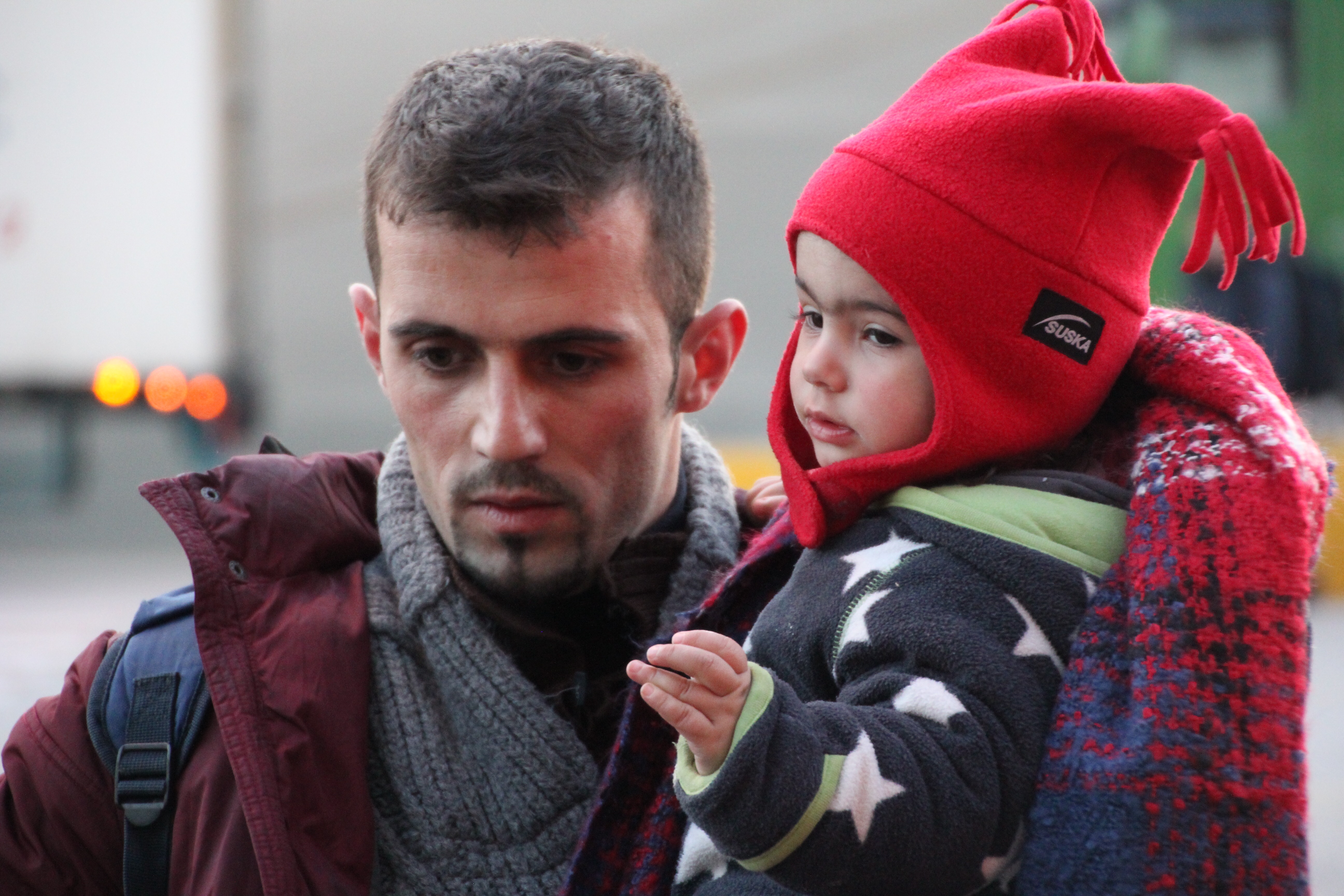
A young father and his son arrive at the port in Athens, Greece.
Over the past two weeks I have been blogging about what our Catholic Relief Services Global Fellows delegation saw and did while in Greece and Serbia. The mission was enlightening for us because nothing in the media back home really captured a sense of the refugee crisis or the humanitarian response taking place. We heard stories of great bravery and desperation and saw aid and assistance given to people who did not expect it. Each of us have been trying to convey to our fellow countrymen the scope of the situation, who the refugees are, why they are fleeing and the aid being provided. I am humbled by the dedication and youth of many of the aid workers. I am proud to report about the work done by CRS staff to help organize and support the various charitable organizations, including Caritas. I am also somewhat amazed when a fellow American sincerely asks, “Why should Americans care, isn’t this a Middle East and European problem?
Over the next week I want to explain why I believe everyone should care, especially Americans. By ‘care’ I don’t mean adopting a position that advocates stopping the migration or ‘sending them back’ but why we should try to understand the cause for the refugee migration, aid those fleeing and actively work to see an end to the violence so Continue reading “Refugees…Reasons Americans Should Care”→
The flow of refugees in Serbia is continuous and most of the people are transiting the country, coming from FYROM (Macedonia) to Croatia. This short video tells a bit of their story. Dino, who you will see in the video works for Catholic Relief Services and understands the plight of refugees, he was a refugee during the war in Bosnia and Serbia in the 1990’s. Continue reading “Refugees in Serbia – A Helpful Perspective”→
You may want to see this video, which I found to be congruent with the situation we encountered and tells about some of the good work being done. Following the video, I offer some personal insights into the facts about the refugees and some fiction that should be dispelled.
One thing that is constant in the world is that despite troubles and hardships, children are always ready to play and exhibit joy. When we arrived at the Serbian rest area where refugees are held waiting for the train to Croatia we spotted a Caritas volunteer blowing soap bubbles for the kids. What did the kids do? The same thing that all kids in the world do, they chased them, popped them and laughed with glee. Even the 10-13 year olds got in the action.
The time that these volunteers spend with the children affords their parents time to rest, plan and discuss their status with the lawyers and consultants provided by Caritas and the Balkans Centre for Migration, supported by Catholic Relief Services. This is actually therapy for the children too since they have spent days on end on buses, trains and boats. Hopefully this little break from what is essentially an adult life lets them be children for just a little while. Their laughing and shouting is just what we would hear from our own children or grandchildren!
Sometimes in the midst of troubles and problems you just spot something humorous. This sign was in a Greek restaurant. The top, in Greek says “Staff Only.” I guess this is where they stuff the staff. Actually, their translation from Greek to English would be a lot better than mine from English to Greek!!!
Deacon Scott Haner, of Louisville and CRS Global Fellow provides his observation of the work being done for the refugees in the Balkans:
Today’s global refugee crisis represents a “river of humanity” moving at levels not seen since the close of World War II. As refugees travel for many months to reach places where they can seek asylum, they have many needs – food, warmer clothing, medical care, shelter, etc. And let’s not forget their psychological needs; this is a time of great stress and anxiety. I was heartened by the myriad of groups, from all faith and secular traditions that focused on the need and volunteered to help the refugees. Catholic Relief Services (CRS), local Caritas groups, Balkans Center for Migration, Foundation Ana and Vlade Divac, Orthodox Philanthropy, Doctors without Borders, World Vision, and the Red Cross all working together. They hold coordination meetings weekly and execute in flawless fashion. It’s nice to see likeminded organizations focusing on a common goal and making a real difference for those in need.
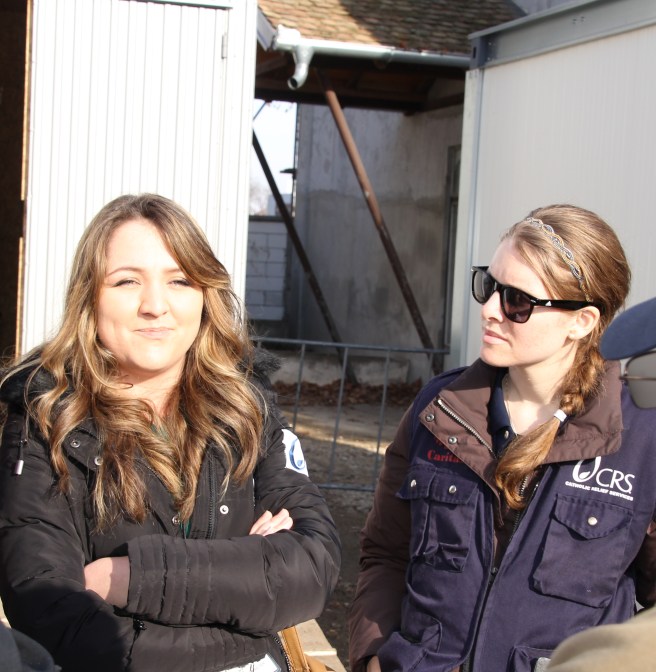
Nejra Hodzurda (left) with Erin Mackey in Serbia, near the Croatian border.
In my last post I mentioned the interpreter, Nejra Hodzurda who directed a pregnant woman to the clinic. The woman was subsequently taken to the hospital. I located a picture of Nejra and I thought you should see her. She is like so many of the aid workers that we met; young, dedicated and effective!
Deacon Scott Haner is a CRS Global Fellow who was part of our delegation. He provides this story that he heard from aid workers near the Serbia-Croatia border:
Nejra Hodzurda is an interpreter in Serbia who works with refugees to explain next steps and offer necessary assistance. It gives great comfort and reduces anxiety for refugees to speak with someone who knows their language.
A woman who was more than 7 months pregnant, came to the bus to train transfer station feeling a great deal of pain. She assumed it was from the stress of the journey. Taida urged her to go to medical room where after a quick examination it was determined a more thorough exam was needed. The doctors in the clinic arranged to transport her to a local hospital. After an ultrasound was done, the mother was informed she would have a daughter soon. Her medical condition was treated and after a few days rest she was given medicine for the onward trip.
The new mother was so grateful for the assistance; she promised to name her baby girl Nejra after the interpreter. The actions by Nejra saved the life of the baby and possibly the mother. For Nejra it was just another day caring for people in need, for the woman it meant life itself.
A young volunteer with the Boat Refugee Foundation (Bootvluchteling) of the Netherlands helps an arriving refugee couple in Athens Greece.As previously mentioned in a post, refugee aid organizations are collaborating in Greece where the refugees from war impacted areas are arriving. Caritas Athens coordinates the activities of many of these agencies to avoid overlap and fill gaps as best they can. Caritas Athens and Catholic Relief Services are partnering with an organization that I would like to tell you about.
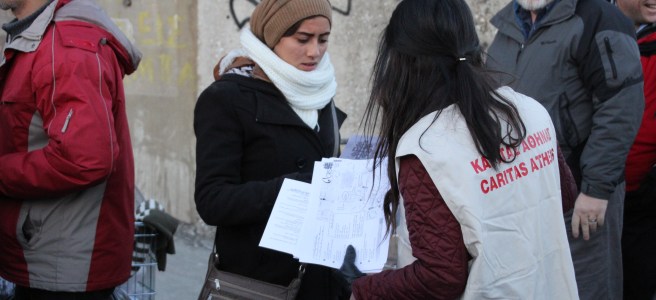
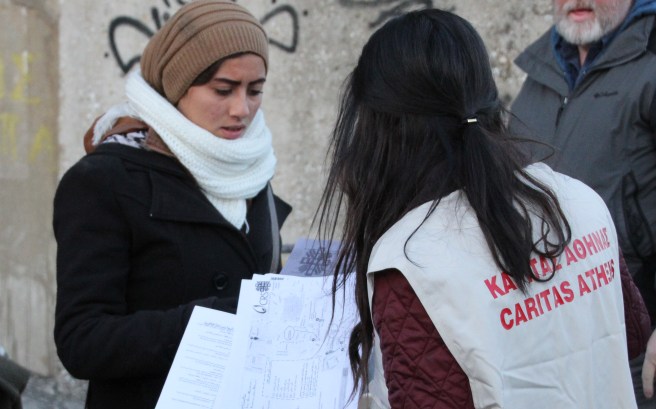
A mother gets information at the Athens port after crossing the Aegean Sea.When we each agreed to participate in the Catholic Relief Services Global Fellows trip to the Balkans we knew we would encounter many refugees and have an opportunity to spend time with some of them to better understand the human dimension of the overall refugee problem. We knew there would be some commonality in the personal stories but that each story would be as unique as the person we were sitting with. Among all of the people that we encountered there are some that particularly stand out and we will remember them the rest of our lives. For me, a woman named Hiat is in this category.
Briefly, Hiat is a woman in her 30s who is a refugee from Syria. We met her with five of her six children at a free hotel in Athens which is run by Caritas Athens and supported by CRS. Hiat is the only adult in her family because her husband was killed in the Syrian civil war a short while ago. Hiat is beautiful with a wonderful smile that we only got to see when we complimented her children. She is exhausted and fearful.
It is not only difficult but it can be dangerous for a woman to travel this route without a male companion. This is not due to danger from her fellow refugees but from those who would prey on the vulnerable. We heard stories of smugglers taking vast sums of money from refugees for transportation when a cheap bus ticket would suffice and others who told of the Bulgarian police “examining” the refugee’s meager possessions and stealing whatever they wanted, including money.
Hiat, had arrived in Greece the day we met her and did not know when she would leave. She was worried about her children as any mother would be. In a real way, she is trapped. She fled Syria to save her children from war after her husband’s death, she is now in Greece where she has 30 days to move forward, request asylum or be returned to Syria. In addition, she fears some of her children might not survive the onward journey. Hers is not the anguish of a mother who is a nomad, a pioneer or one living in the Middle Ages. She is a 21st century mother on the run who just a few years ago had a husband, home, children and future.
Hiat is receiving help from CRS and Caritas Athens, she and her children have a warm room, they will receive two meals each day and she can get counseling and assistance to plan and understand the next phase of her journey, but she has hard decisions to make.
There is much more to Hiat’s life and story. It is a long post but I encourage you to take the time to read it all and reflect upon it. I ask this not because I’m writing it, but because I believe it will convey to you a more accurate sense of who the Syrian refugees are, what they have left behind and why, as well as their hopes for the future.
Normally, I would post a photo of Hiat and her son on this site. We asked permission to take her picture and she asked that we not do that. Refugees, especially those just arriving need to build trust in those who are helping them. Until that trust develops over the course of a week or two, they can be reluctant to allow photos. We respect her wishes. To see her full story, just click here. Continue reading “Hiat: The Difficult Journey of a Refugee Mother”→





 A Deacon's View